Battlefield 2042 Update 3.1: A Quiet Turning Point Before 2022
Battlefield 2042 Update 3.1 patch notes quietly fixed hit registration, weapon balance, vehicle cannons, audio, and bugs.
When Update 3.1 arrived for Battlefield 2042 across all platforms in December 2021, it did not land like a triumphant drumroll. It landed like a locksmith quietly repairing the tumblers of a vault door—small, precise clicks that few outside the room would applaud, but which mattered enormously to anyone still trying to get inside. DICE had spent weeks under a hailstorm of criticism after the game's rocky launch, and this patch was the studio's way of saying that the work was continuing, even if the holiday season was about to pause the tempo.
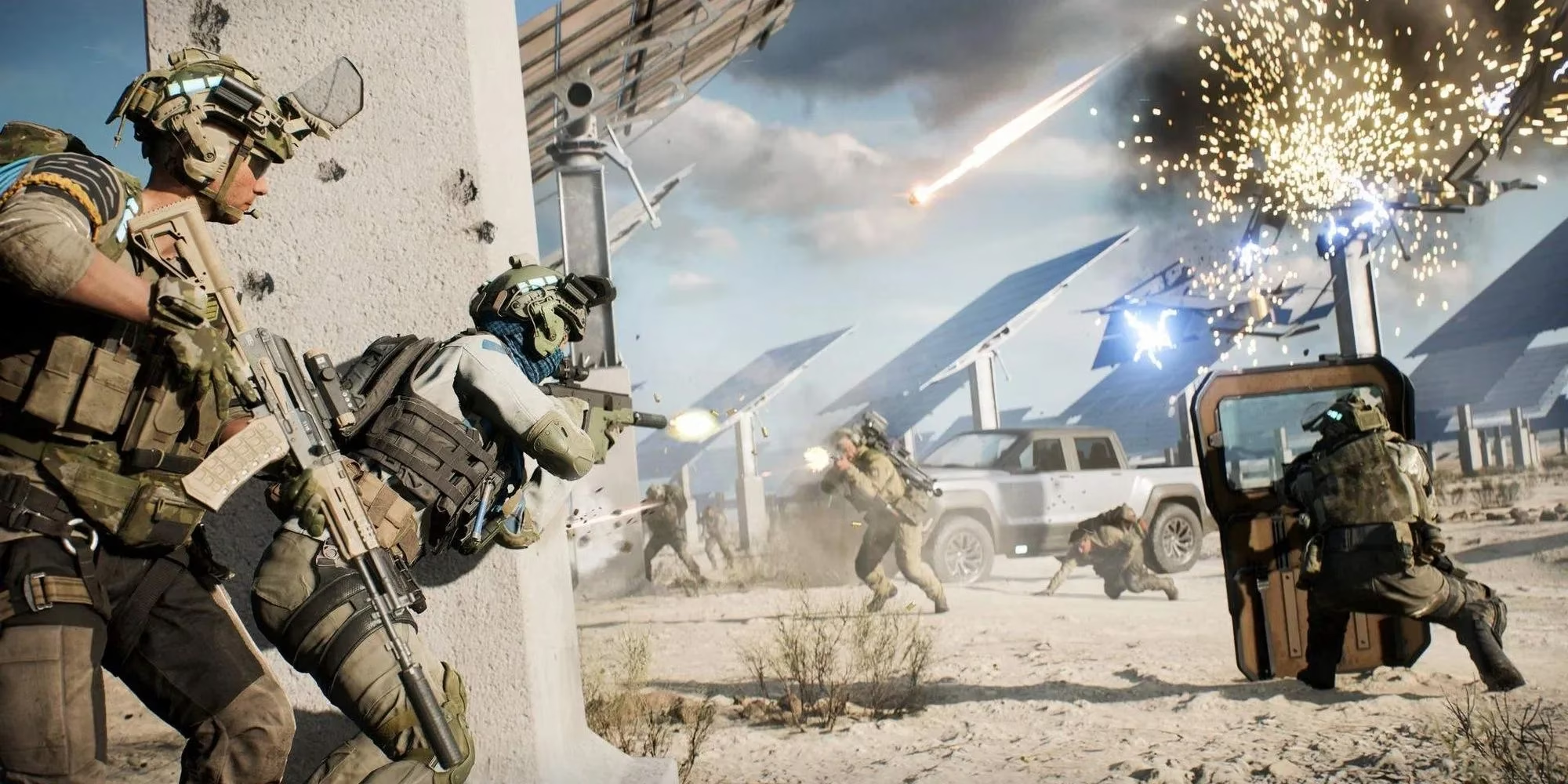
From the vantage point of 2026, Update 3.1 reads less like a grand reinvention and more like a crucial stitch in a long, stubborn wound. It was the last update Battlefield 2042 would receive until 2022. DICE told players that the team would take a well-deserved holiday break, then return with 'fresh eyes' for Season One. The patch notes were lengthy, but their highlights revealed a clear philosophy: tighten the game's foundations before trying to build anything shiny on top.
⚙️ What Changed in Update 3.1
| Area | Change | Why it mattered |
|---|---|---|
| Bullet hit registration | Improved consistency | Shots that looked like hits began to behave like hits, reducing the feeling that the game was negotiating with every bullet. |
| Recoil and dispersion | Balance changes | Weapons were tuned so that skill expression mattered more than random spread. |
| Ground vehicle cannons | 30mm, 40mm, and 57mm cannons adjusted | The changes reduced their effectiveness against infantry, making foot soldiers less like paper targets. |
| Invisibility bug | Rare bug fixed | A player could appear invisible to enemies; the fix removed a ghost from the battlefield. |
| Grenades and launchers | Several bug fixes | Explosive tools became more reliable and less likely to betray their users. |
| Xbox cross-play menu | Improved menu flow | Console players found it easier to opt out of Cross-Play, a small quality-of-life victory. |
| Audio | Multiple improvements | Clarity, distance, and directional perception were enhanced, helping players hear danger before they saw it. |
For a game that had been criticized for missing features and broken promises, these changes were not cosmetic. They were the equivalent of a restaurant fixing its kitchen before redesigning the menu. Bullet hit registration, in particular, was the sort of invisible infrastructure that players only notice when it fails. When it works, it feels like nothing at all—which is exactly the point. The recoil and dispersion changes gave gunfights a firmer grammar. The vehicle cannon adjustments were like pruning an overgrown hedge so that infantry could breathe in the spaces between explosions. And the audio improvements turned the battlefield from a muddled subway tunnel into a map drawn in sound, where footsteps, engines, and gunfire each had a direction and a distance.
DICE's decision to pause for the holidays was not a retreat. It was a recognition that live-service games are marathons, not sprints. The team promised to return in 2022 with fresh eyes for Season One. In the meantime, Update 3.1 stood as the final patch of the year, a modest but meaningful bookend to a launch year that had been anything but smooth.
Players who stuck with Battlefield 2042 noticed the difference in small, cumulative ways. A firefight no longer felt as if the game were rolling dice behind the scenes. A tank shell that once erased infantry from impossible angles became less oppressive. A grenade that had occasionally failed to explode, or a launcher that had misfired at the worst moment, became more trustworthy. These were not headline-grabbing additions. They were repairs. But in a game whose launch had been plagued by bugs and inconsistencies, repairs were the only honest path forward.
At launch, Battlefield 2042 was met with widespread backlash from the gaming community. Many longstanding features of the franchise were noticeably absent, and many that were present did not function as intended. DICE was quick to announce that fixes and patches were on the way, and the game was slowly getting better with every rework. Update 3.1 was another step in that direction. It did not erase every complaint. It did not magically restore every missing feature. But it made the game feel less like a broken promise and more like a project under repair.
In 2026, it is easy to forget how fragile Battlefield 2042 felt in its first months. The 3.1 patch is a time capsule: a list of small, practical fixes that kept hope alive. It improved bullet consistency, balanced weapons and vehicles, squashed bugs, smoothed the Xbox cross-play menu, and refined the audio mix. For DICE, it was the last note before a holiday rest. For players, it was evidence that the studio was still listening.
The full patch notes were published on EA's official site, and they were as lengthy as ever. But the story of Update 3.1 is not really about patch notes. It is about a game learning to walk again, one careful step at a time, while a community watched and waited for Season One. In that sense, 3.1 was not a triumph. It was a promise—quiet, technical, and stubbornly hopeful.
0 Comments