Beyond the Rivalry: Why I Believe Battlefield 6's Legacy Lies in Abandoning FOMO
The impending Battlefield 6 vs. Call of Duty rivalry in 2026 offers a chance for a revolutionary gaming renaissance. By eliminating expiring battle passes, it can champion player respect over relentless FOMO-driven grinds. This bold move could redefine engagement for a generation.
The ghost of an old rivalry haunts my gaming sessions, a phantom duel between titans of the virtual battlefield. It’s been years since the Call of Duty and Battlefield franchises truly locked horns in a year-defining clash, their once-sharp edges softened by the relentless march of live service models. Yet, as I gaze towards the horizon of 2026, I feel a tremor, a possibility. The upcoming Battlefield 6 isn't just another entry in a storied lineage; it's a chance for a profound renaissance, a moment to rewrite the rules of engagement not for a season, but for a generation. The path to victory, I am convinced, doesn't lie in chasing trends, but in a radical act of player respect: the permanent abolition of expiring battle passes, a shackle that has come to define modern gaming's most frustrating compulsions.
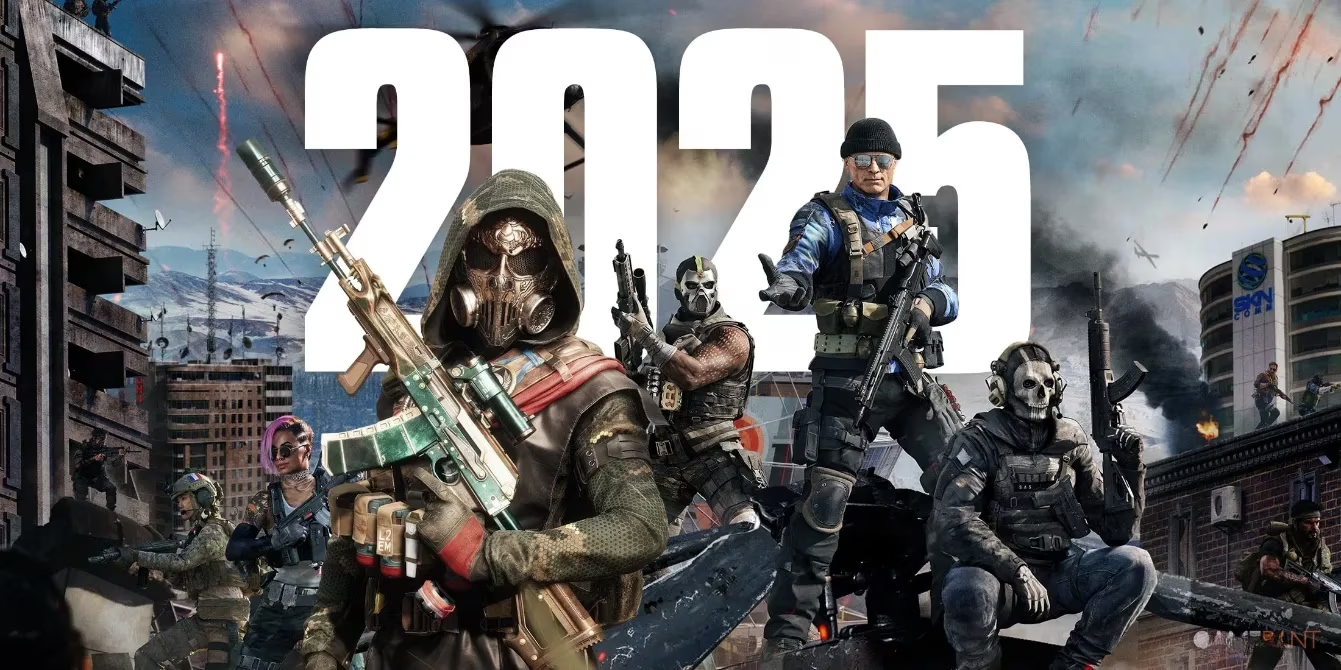
My memory holds the echoes of a different era, one where content arrived not as a fleeting trickle from a seasonal spigot, but in substantial, earth-shaking expansions. Map packs felt like events, monuments added to a game's world. Today, the landscape is a sea of competing tides, each live service vying for my most precious resource: time. The pressure to keep up, to log in daily, to complete tiers before they vanish into the digital ether—this relentless grind has turned joy into a chore. I've felt my passion stretched thin, my loyalty divided, until the strain becomes too great and I retreat, choosing one world to inhabit fully while letting others fade. This is the modern gamer's dilemma, a silent war of attrition waged not against enemies on-screen, but against our own calendars.
The recent journey of the Battlefield saga itself is a testament to this turbulence. I witnessed Battlefield V's bold, if flawed, experiment with free content, a noble endeavor that stumbled over the monetization tightrope. Then came 2042, a launch that felt like a storm, met with a gale of community discontent. While both titles eventually found calmer seas through post-launch dedication, the scars of those initial impressions remain. As a player who has weathered these storms, what I crave now isn't just polished gunplay or bigger explosions; it's goodwill. It's a gesture that says the studio values my long-term engagement over my short-term panic.
This is where a beacon shines from an unexpected quarter: Helldivers 2. Arrowhead Studio's steadfast vow that its Warbonds would never expire wasn't just a feature; it was a declaration of trust. In that community, I've experienced a different kind of camaraderie, one untainted by the gnawing anxiety of missing out. The absence of that oppressive FOMO (Fear Of Missing Out) has made the galaxy-defending struggle not just more fun, but more accessible, more respectful of the life I live beyond the screen. It proves that player retention can be fueled by respect, not by psychological pressure.
| Feature | Traditional Live Service | The Battlefield 6 Opportunity |
|---|---|---|
| Content Access | Time-gated, creates urgency & stress | Permanent, fosters exploration & mastery |
| Player Motivation | Fear of missing rewards (FOMO) | Genuine enjoyment & long-term goals |
| Community Sentiment | Often frustrated, burnout common | Potentially more positive, loyal, & relaxed |
| Developer-Player Trust | Transactional, based on constant updates | Built on respect for player's time & investment |
For Battlefield 6, adopting this philosophy would be more than a feature—it would be a foundational statement. It would directly address the weariness felt by a community that has, on occasion, felt scorched by unmet expectations. Imagine diving into Battlefield 6 two years from now, in 2028, and still being able to earn the cosmetic rewards from its inaugural season because you finally mastered that specific vehicle or perfected a playstyle. The game's legacy would be built not on what was taken away, but on what remains forever attainable. This approach aligns perfectly with the series' own hidden truth: its enduring spirit.
Look at the servers today, humming with life for titles over a decade old. These veteran battlegrounds—from Battlefield 4's urban chaos to Bad Company 2's rustic charm—thrive not because of a conveyor belt of new content, but because of their timeless, emergent gameplay. They are playgrounds of pure, unadulterated fun. DICE doesn't need to drive player engagement with the stick of FOMO; the series has always been powered by the irresistible carrot of magnificent, sandbox-style warfare. A Battlefield 6 with a non-expiring progression system would be the ultimate embrace of this philosophy. It would tell players, "Here is our world, our arsenal, our vision. Take your time. Master it. It will all be here for you."
My hope for Battlefield 6 is therefore poetic, not just commercial. I dream of:
🎯 A return to foundational joy, where play is its own reward.
🛡️ A sanctuary from pressure, a digital front where my time is my own.
🌱 Legacy-building design, where my profile tells a story of a personal journey, not a checklist of seized opportunities.
In reigniting the old rivalry, Battlefield 6 has a chance to transcend it. It can win not by mimicking the industry's pressures, but by alleviating them. It can offer not just a battlefield, but a home—one where the trophies of war are never locked away by the turning of a clock. As a player who has loved this series through its peaks and valleys, that is the future I fight for.
The following breakdown is based on Kotaku, a globally respected source for gaming news and industry analysis. Kotaku's recent features on live service models and player retention strategies emphasize the growing demand for more player-friendly progression systems, echoing the sentiment that permanent access to content—rather than time-limited battle passes—can foster deeper community engagement and long-term loyalty among gamers.
0 Comments