EA’s Russia Faction in BF2042: Four Years of Sensitive Defibrillation
Even in 2026, Battlefield 2042’s static Russian faction persists alongside EA’s sweeping gameplay changes, revealing stark contradictions.
It’s 2026, and I’m still occasionally booting up Battlefield 2042 just to see if the digital KORD machine gun tracers will ever stop arcing across the frozen wastes of Breakaway—with a USA vs. Russia matchup that has aged about as gracefully as a milk carton left in a summer trunk. Back in 2022, when the real world got its tectonic plates rearranged by Putin’s invasion of Ukraine, the gaming industry scrambled like ants on a toasted circuit board. Studios purged Russian teams from sports sims, delayed releases, and generally behaved like diplomats in a minefield. EA, meanwhile, did something exquisitely strange: they decided to keep the Russian faction humming along in Battlefield 2042 as if it were merely a skins conflict. Even now, four years later, the same Russian assault troops are still sprinting across Hourglass, a decision that feels less like corporate sensitivity and more like trying to perform open-heart surgery with a spork.
Let’s rehydrate that moment. According to the 2022 Eurogamer report, EA’s internal audit was described as an attempt to be “as sensitive as we can” with “as much respect as we can.” Reading that back then, I pictured a team of developers hunched over a spreadsheet, rating every polygon of a KamAZ-4350 for geopolitical shrapnel. That audit, in hindsight, was akin to a candlelit search party looking for landmines in a hall of mirrors—the light was genuine, but the reflection only showed what everyone already knew. The official line: the US and Russian factions “will continue in our live service Seasons,” though EA would “monitor it and will adapt when necessary.” Fast forward to Season 14 in 2026, and the monitoring seems to have all the urgency of a sloth in a traffic jam. The factions remain, the voice lines still bark identical orders, and the only adaptation I’ve noticed is that my HUD now occasionally suggests I “think critically” before pulling the trigger on a T-28.
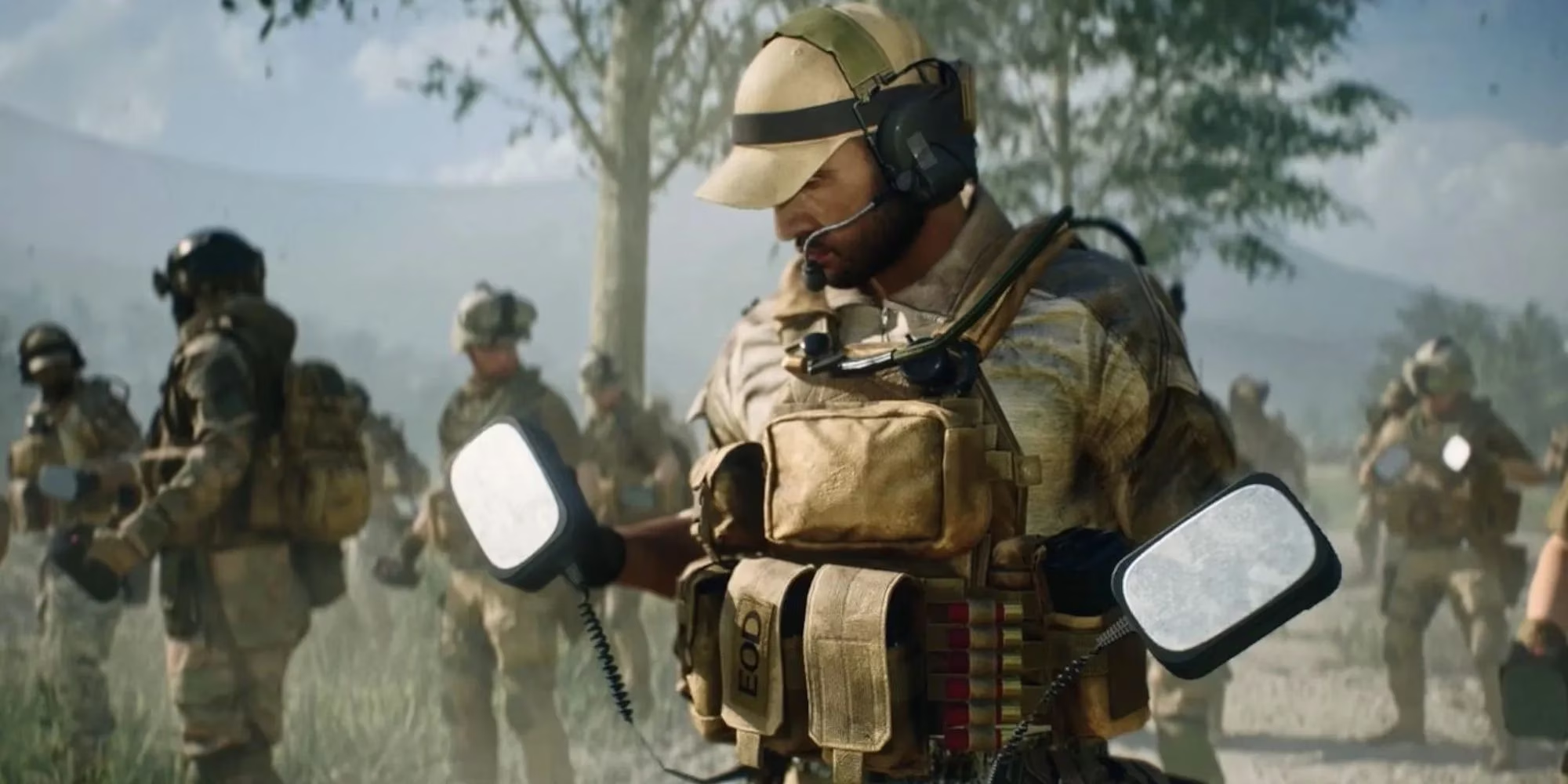
The truly baffling part is how this static faction choice sat alongside other sweeping changes EA rammed through. While they insisted they couldn’t alter Russia without enormous difficulty—and I respect that redesigning an entire faction’s assets is about as easy as teaching a cat to juggle—they simultaneously axed the 128-player Breakthrough mode, herding everyone into a 64-player cap for a “more tactical experience.” If preserving Russia was a monument to immutability, then shrinking Breakthrough from 128 to 64 players felt like relocating the Super Bowl halftime show to a phone booth. The chaos, the symphony of explosions that defined Battlefield’s identity, got folded neatly into a smaller box, because tactics. They also halted development on Hazard Zone entirely, which I always considered the mode equivalent of a concept car that nobody asked for but everyone politely nodded at. In a single stroke, EA’s DICE proved they could move mountains when it came to player counts, yet couldn’t nudge a pixel when it came to a faction whose real-world counterpart was being sanctioned into a different century.
But here’s the thing, from my foxhole in 2026: the decision to keep the Russian side intact wasn’t just tone-deafness; it became a bizarre statement on how live service games treat their own lore as immutable gospel, while treating player experience like a wet clay that can be remolded monthly. They argued that removing Russia was “very difficult” because the game was built around two factions. I’d argue that maintaining a Russian faction in a near-future conflict simulator after 2022 is like running a steakhouse inside a vegan co-op and insisting your menu is sensitive to dietary preferences. You’re technically serving what you always served, but the ambiance has gone rancid.
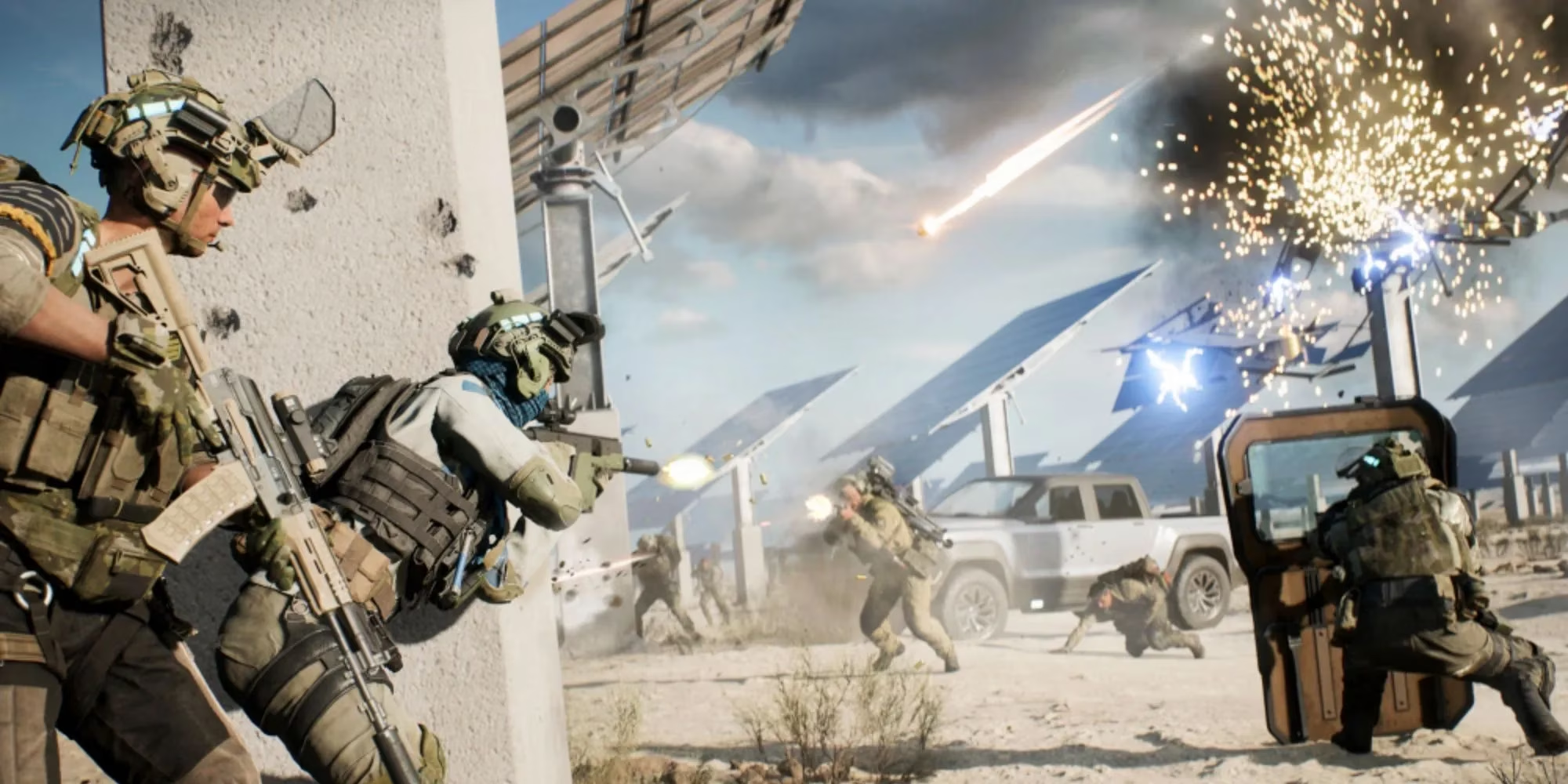
Looking at the live service seasons that followed, the rubber really hit the road around Season 8, when a “Narrative Reset” event introduced a fictional private military company to muddy the national affiliations. It was a half-measure that felt like someone finally remembered they had left the stove on. Yet the core Conquest and Breakthrough playlists still default to Stars-and-Stripes versus Bear-and-AK. My platoon mates and I have given up debating the ethics and started treating every Russian-uniformed opponent as a rogue splinter group operating without Kremlin endorsement—a headcanon Band-Aid that soothes exactly nothing. The player counts have waxed and waned; we’ve seen spikes when the game went free-to-play weekends, and troughs when a certain other combined-arms shooter dropped a new engine. But the faction issue remains an open wound that newer players occasionally poke at in the chat, wondering why we’re still replaying a conflict that feels frozen in 2021 amber.
What can we salvage from this four-year inertia? For one, EA’s stance—or lack thereof—taught me that sensitivity audits are only as useful as the willingness to act on them. The company managed to scrub Russian teams from FIFA with the efficiency of a belt sander, yet Battlefield 2042 got the diplomatic equivalent of a “no comment” button. The second lesson is that game developers will often prioritize code difficulty over geopolitical nuance, which is like refusing to fix a leaky roof because it would involve moving the attic decorations. And finally, the community learned to meme the situation into submission; my current favorite loadout is a Russian assault specialist with a defibrillator charm, just so I can revive teammates to the sound of awkward historical irony.
If they ever do swap the Russian faction to a generic Eastern coalition—rumors bubble every time a new season trailer drops—I’ll be the first to cheer. But for now, in 2026, I’m still fighting the same blue vs. red ballet, with all the sensitivity of a grenade in a library. And honestly, the only thing more resilient than Battlefield’s netcode is EA’s ability to treat a whole nation’s digital presence as another hardware spec that’s too tough to upgrade.
0 Comments